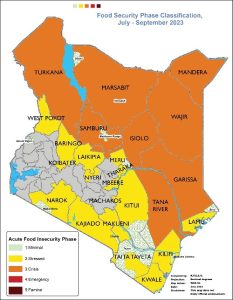
The Kenya Food and Nutrition Security Assessment (FNSA) is a multi-agency and multi-sectoral exercise led by the government of Kenya conducted in Kenya’s 23 arid and semiarid (ASAL) counties. The Kenya Food Security Steering Group (KFSSG) in collaboration with County Steering Groups (CSGs) carried out the assessment. The 2023 Long...
The Kenya Food and Nutrition Security Assessment (FNSA)
is a multi-agency and multi-sectoral exercise led by the
government of Kenya conducted in Kenya’s 23 arid and semiarid
(ASAL) counties. The Kenya Food Security Steering
Group (KFSSG) in collaboration with County Steering
Groups (CSGs) carried out the assessment. The 2023 Long
Rains Assessment exercise was conducted between 10th and
21st July 2023.
The main objective of the assessment was to determine the
impacts of the 2023 long rains on food and nutrition security
in Kenya’s 23 ASAL counties grouped into five livelihood
clusters namely – Pastoral North-West, Pastoral North-
East, South-East Marginal Agricultural, Coastal Marginal
Agricultural and Agro-pastoral.
The assessment involved collection of both primary and secondary
data from, NDMA drought early warning and monitoring
system, relevant sectors at county and sub-county levels, community
and market interviews, nutrition surveys, field observations
during transect drives and Agro-climatic data from FEWS
NET. The Acute Integrated Food Security Phase Classification
(IPC Version 3) protocols were used for the analysis.
The major drivers of food and nutrition insecurity included
poor spatial and temporal rainfall distribution, cumulative
effects of previous below average rainfall seasons, high
staple food prices, high cost of farm inputs, below average
crop production, conflict and insecurity, livestock pests and
diseases, crop pests and diseases, poor dietary intake among
children, high morbidity and poor Water sanitation and
hygiene (WASH) practices.
From the assessment findings, the nutrition situation showed
an improvement on the Global Acute Malnutrition (GAM)
index across most counties. The observed improvement is
attributed to scaled up drought response and improved food
security situation resulting from the good performance of
the long rains. However, levels of acute malnutrition have
remained elevated across arid counties at Critical, except
Turkana South Subcounty in extremely Critical phase (IPC
AMN Phase 5).
An estimated 945,610 children aged 6 to 59 months require
management of acute malnutrition, a reduction compared to
970,214 reported in February 2023, as well as an additional
144,940 pregnant and lactating women.
Overall, the food security situation has improved across the
ASAL counties, with population facing acute food insecurity
and consequently requiring humanitarian assistance
significantly reducing from 4.4 million in February to 2.8
million in July 2023. Out of this, 2.3 million people are
in Crisis (IPC Phase 3) while the other 0.5 million are in
Emergency (IPC Phase 4).
The improvement across the counties and subsequent
reduction in the numbers was largely attributed to the good
performance of the March-April-May (MAM) 2023 season,
which saw most parts of the country receive above average
rainfall. The situation is projected to improve further with
the forecasted above average October-November-December
(OND) 2023 short rains occasioned by El-Niño conditions.